Work that doesn't fit on a CV: things I've designed and built on my own time. This list will keep growing.
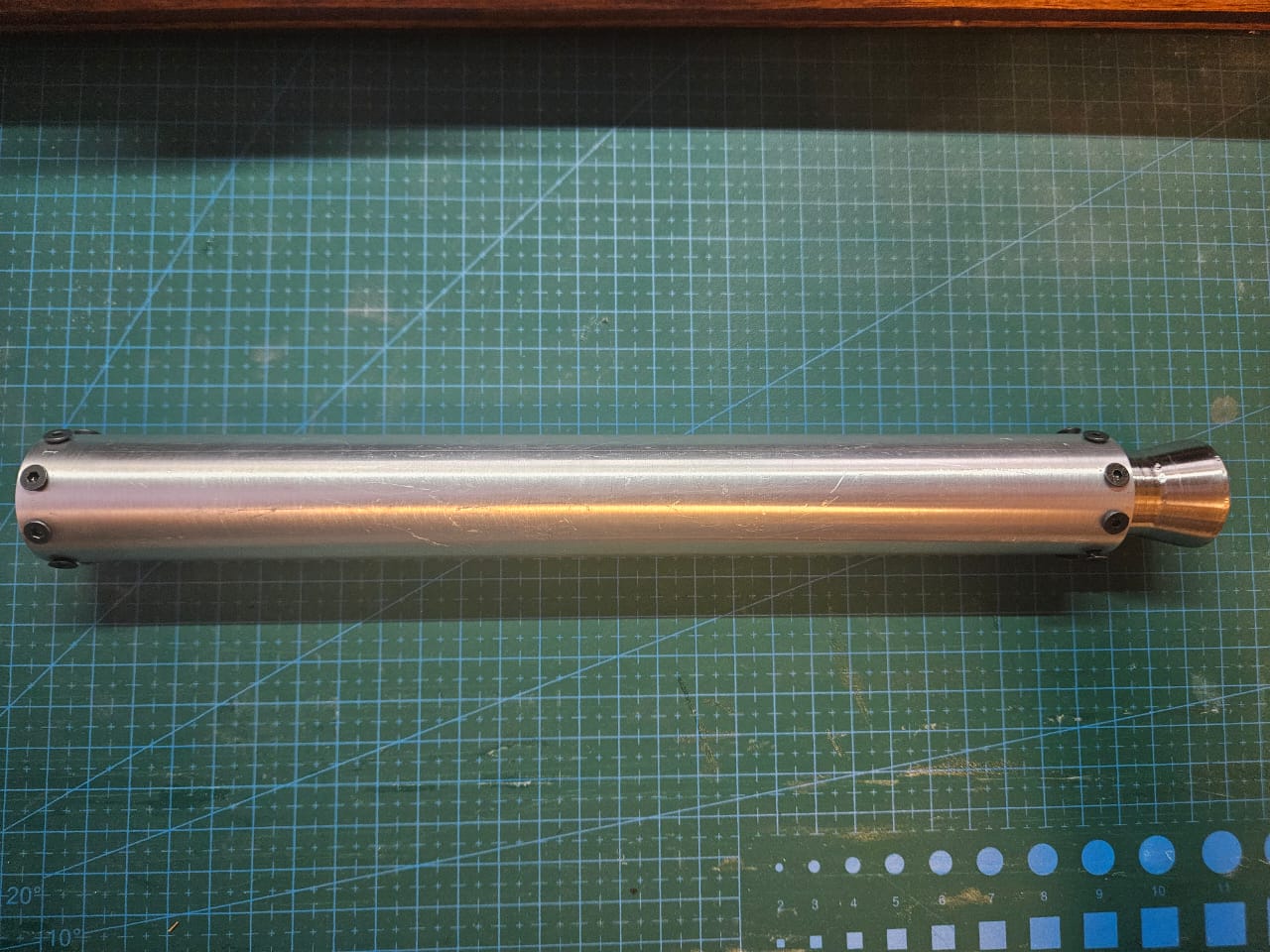
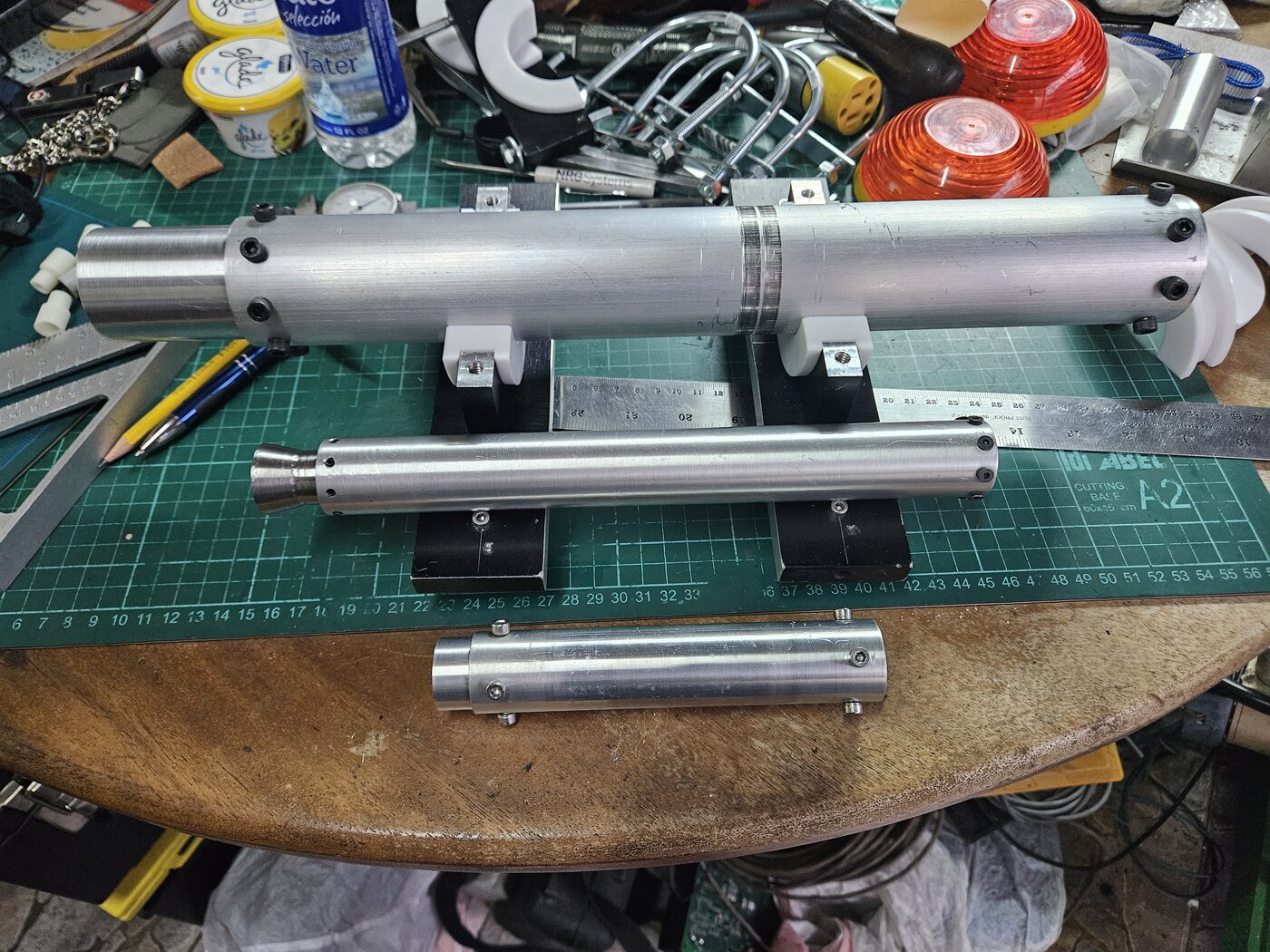
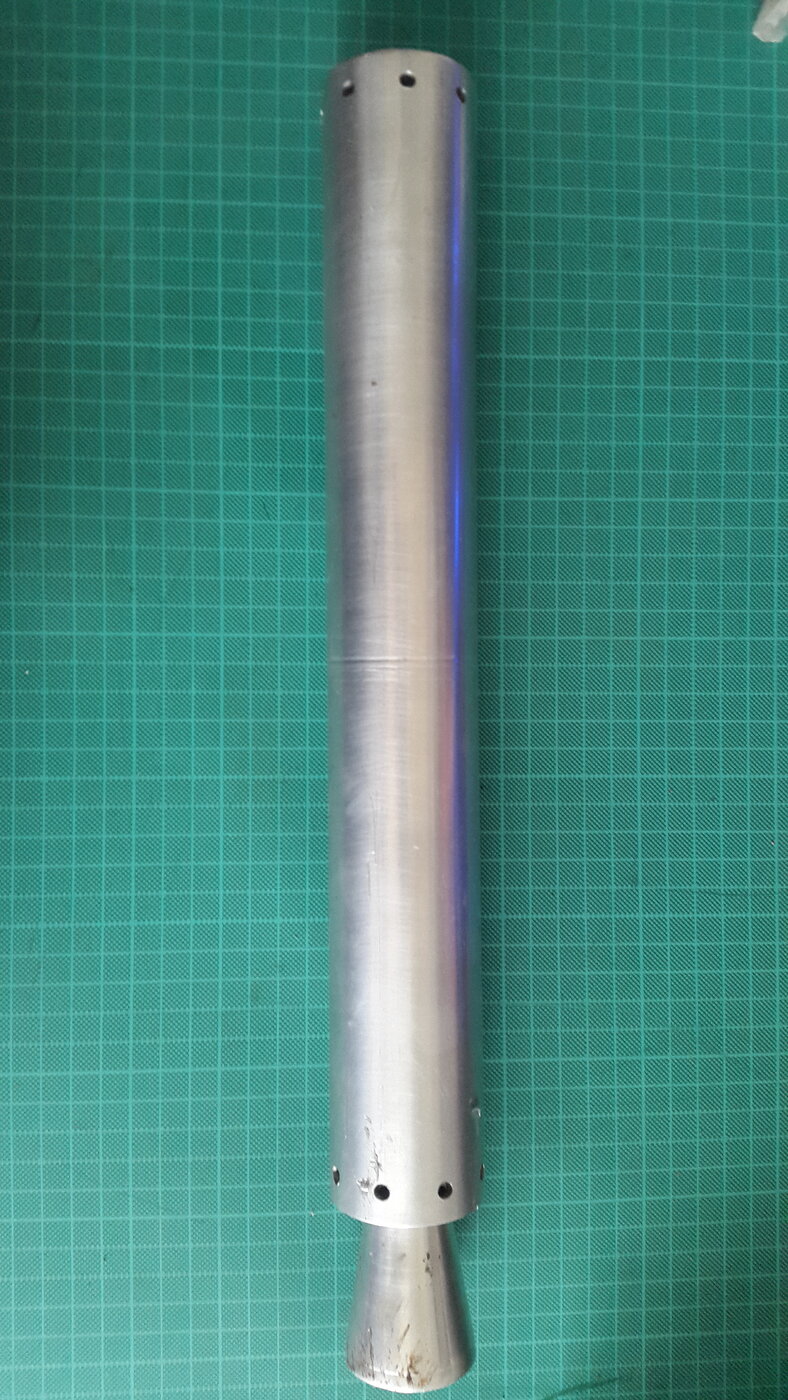
I designed this motor in September 2025 with a specific goal: fit a 38mm mount, the most common motor diameter among rockets built in Costa Rica. Most of my earlier motors used non-standard diameters, which meant they only worked with rockets designed specifically around them. This one I wanted anyone with a 38mm rocket to be able to use.
The design uses four BATES grains of KNSU propellant (65/35), with a 6061-T6 aluminum casing and an AISI 316L stainless steel nozzle. I documented it as a formal assembly under part number ACC-H374, with drawings, a bill of materials, and performance estimates: an estimated total impulse of 172.58 N·s, specific impulse of 131.76 s, and a total mass of 375.3 g.
I built it between September 2025 and the test on May 1, 2026. The real results came in somewhat below the design estimate: a total impulse of 150.6 N·s and a specific impulse of 118.07 s, with peak thrust around 440 N. It's a curious result — below the 160 N·s that marks the boundary into H-class, this motor ended up performing, in practice, more like a G-class motor than the H374 its name suggests. Still, it met the main goal: it's a 38mm motor, ready to use in most rockets built in the country.
Video of the successful static fire, March 28, 2026.
Part two of this project: seven years after the original nozzle suffered severe erosion during the 2019 test (Part 1), I picked the J motor design back up between 2024 and 2026 to address that root cause. The main change was a new nozzle — aluminum with a stainless steel insert at the throat — designed to better resist the erosion that had destroyed the original. The stainless insert itself showed no erosion after the test, but the rest of the nozzle did show some — a real improvement, though the problem wasn't fully solved and remains something to refine in future iterations. I also redesigned the grain mold for better consistency between batches, split the charge into 4 grains of 70 mm each instead of 3, and updated the simulation methodology, moving from the original Excel spreadsheet to the Python desktop app I built between 2020 and 2022 (Motor Design and Modeler).
I tested the motor on March 28, 2026, on an instrumented test stand I designed and built as a personal project, which I loan to the Asociación Costarricense de Cohetíería for its test days. That closed a different loop: the original 2019 test had lost its validity because the test stand at the time took flight during the burn. This time the data came out clean and consistent with expectations: an Isp of 111.09 s, 670.42 N·s total impulse, 939.77 N max thrust, and 1.2 s of effective burn time.
Video of the explosion during the first test, May 20, 2016 (GoPro footage).
Video of the explosion during the second test, July 12–13, 2016.
Video of the successful test, March 28, 2026.
This is probably my oldest and longest-running project: I started machining this motor's casing in mid-May 2016, during my early years at the Aerospace Engineering Group (GIA), and it handed me fresh data again this year. It's, without exaggeration, the motor that taught me how to design rocket motors — every failure across a decade ended up pointing at exactly what I needed to understand better.
The first test, on May 20, 2016, ended in an explosion: the nozzle detached from the motor body and flew off, never to be recovered. It was caught on video from two different cameras. The load cell I'd mounted for that test didn't survive either — the first of two I'd end up losing to this motor. The suspicion that the aluminum casing tube was defective is what led me to open the aluminum 6063 material investigation I document separately: there, we confirmed the material wasn't the problem — the propellant characterization was.
I tried again two months later, machining a new motor from scratch. The second test, on July 12–13, 2016, ended exactly the same way: the nozzle detached and was lost again, and a second load cell was destroyed. Two explosions in a row with the same failure — nozzle retention — are what really taught me to question every assumption before questioning the physics.
The next documented test came three years later, in August 2019, this time as a collaboration between GIA and TECSpace — one of several times this project ended up connecting different rocketry groups across the country.
Between 2018 and 2021 I revisited the design in CAD, with formal assembly drawings, toleranced dimensions, and a simulated design report from the tool I'd later develop (Motor Design and Modeler). The new design went straight after the failure I'd seen twice: the nozzle went from simply fitted in place to bolted to the motor body.
On March 28, 2026, at one of the ACC's test days, I put a G-class KNSU motor on the stand again — same design lineage, a decade later. This time the data came out clean: a peak thrust of about 68 N, with a consistent, unsurprising burn curve. The video from that test, next to the ones from 2016, is almost boring to watch — no bang, nothing flying off. Ten years and two lost nozzles later, having a boring, predictable thrust curve felt, in a strange way, like the best proof that the learning had paid off.
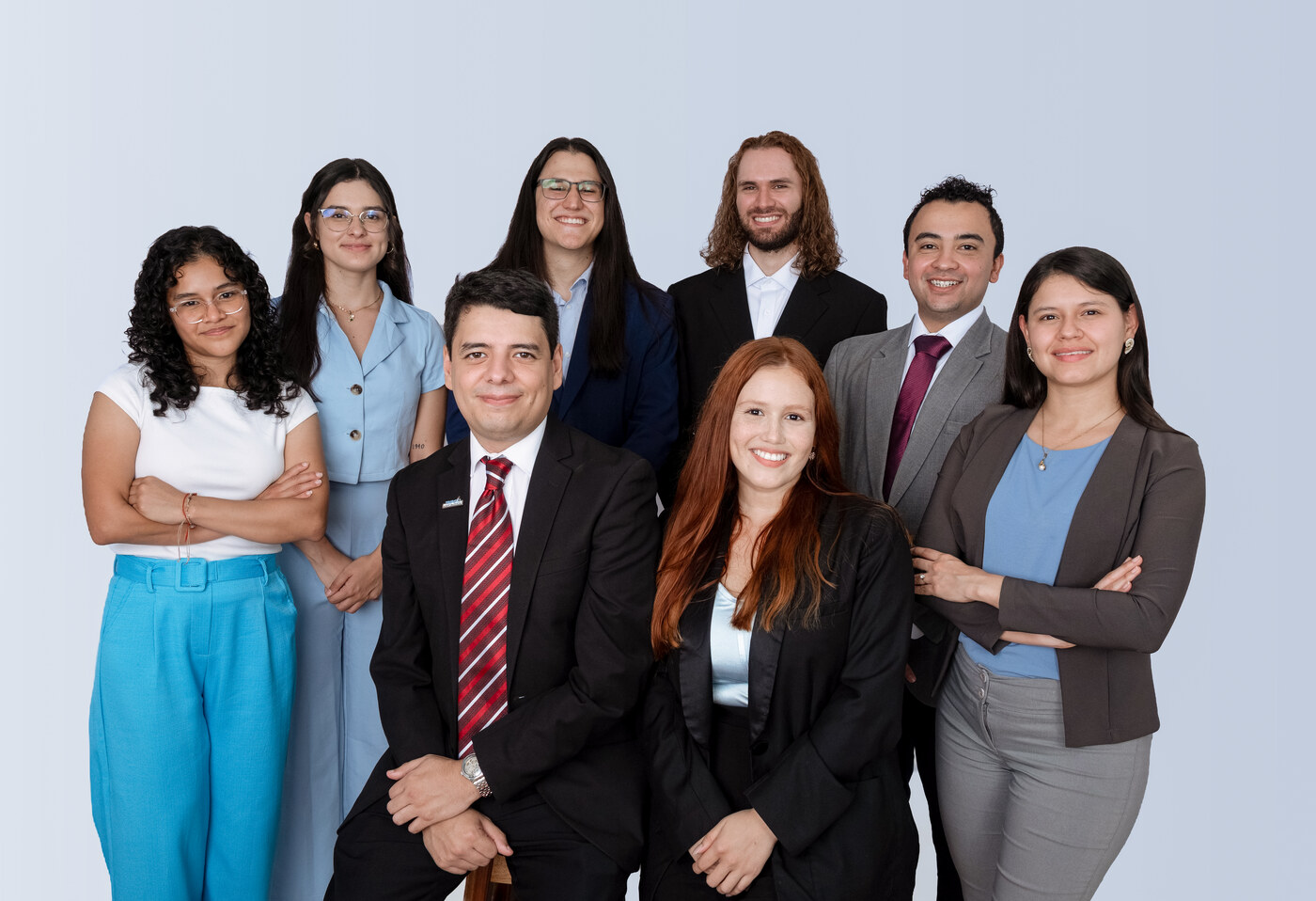
The push to create the Asociación Costarricense de Cohetería (ACC) began in late 2023, as a response to the excitement generated by the first Central American Space Congress (Congreso Espacial Centroamericano, CEC): we decided it was the right time to found both a TRIPOLI prefecture in Costa Rica and a formal association to back it legally. The original group that kicked off the project was different from the one that makes up the organization today, and formalizing it took time: the ACC was officially founded in 2026.
Today I'm President of the ACC and Prefect of TRIPOLI Costa Rica. I also took on the role of Range Safety Officer (RSO) — the person with the authority to halt any operation and responsible for preventing incidents at events involving high-power motors and explosive hazards — a role that hadn't formally existed before I took it on.
Through the association I've taught rocketry and propulsion courses and programs at several institutions: basic rocketry for TECSpace (April 2024, 30–40 people), rocketry for kids with the Municipality of Paraíso, including launching a mini rocket (February 2025), a 6-week theory/practical propulsion course for UCR's GIA (March 2025, about 25 people), ongoing mentorship for the Fidespacial student group at Universidad Fidélitas (first half of 2026, about 10 people), and a weekend introductory rocketry course for the Spacelabs student group in San Carlos (November 2023). We're currently planning the association's first official launch and working toward the country's first rocketry certifications.
coheteriacr.org ↗Video from one of the ACC motor test days.
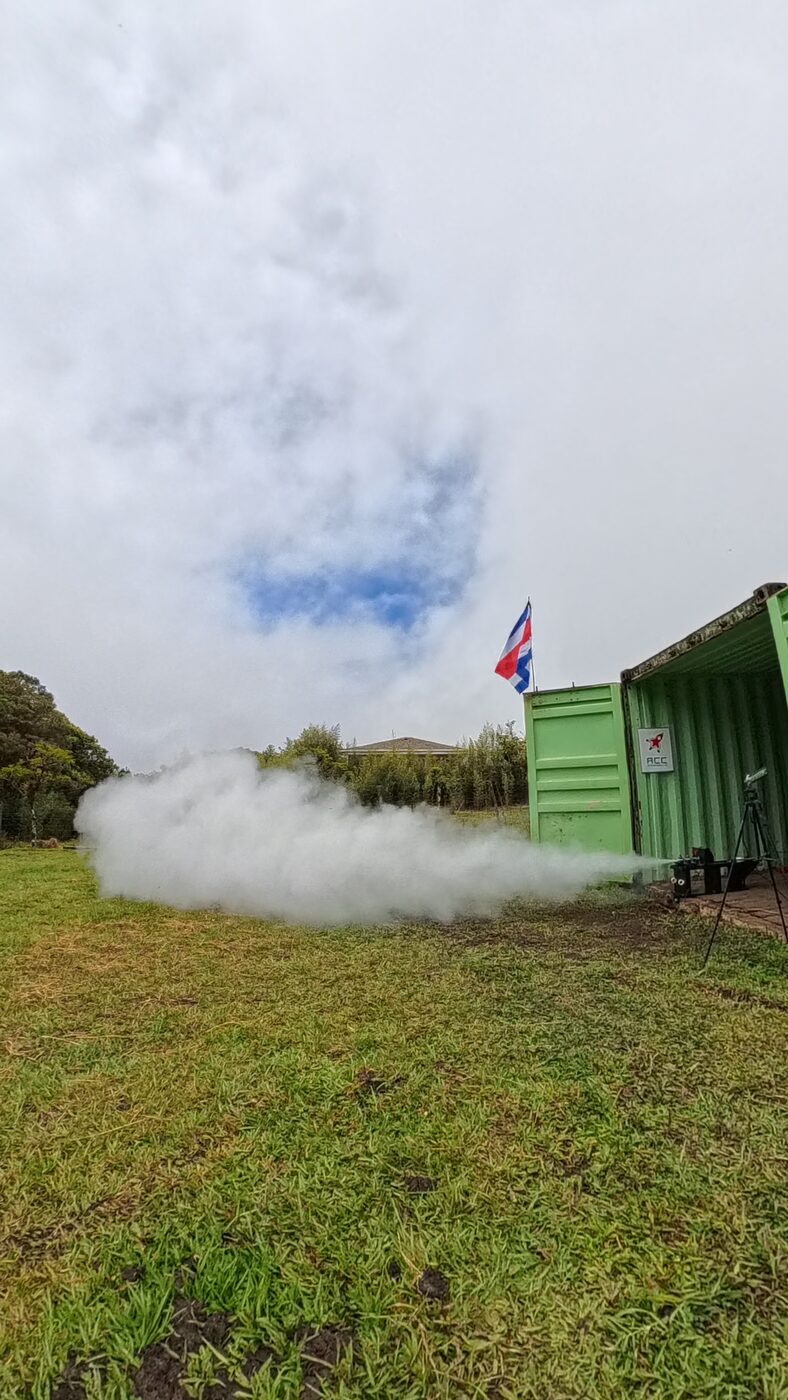
As part of my role at the ACC, I organize public motor test days: anyone with a rocket motor they want to test can bring it and fire it under controlled conditions. We've run two so far, on March 28 and May 1, 2026, using my personal test stand, with me acting as Range Safety Officer (RSO) — with the authority to halt the operation at any sign of risk.
Video from one of CRATER's K-class motor tests.
Through the ACC, we've supported CRATER, the rocketry team of UCR's Aerospace Engineering Group (GIA), in developing their K-class motor, lending them my personal test stand and providing technical and safety support across their 3 tests — sparing them from having to build their own test infrastructure from scratch. One of those tests took place at TEC's San Carlos campus, with the ACC acting as mediator between the two institutions.
www.instagram.com/crater.gia ↗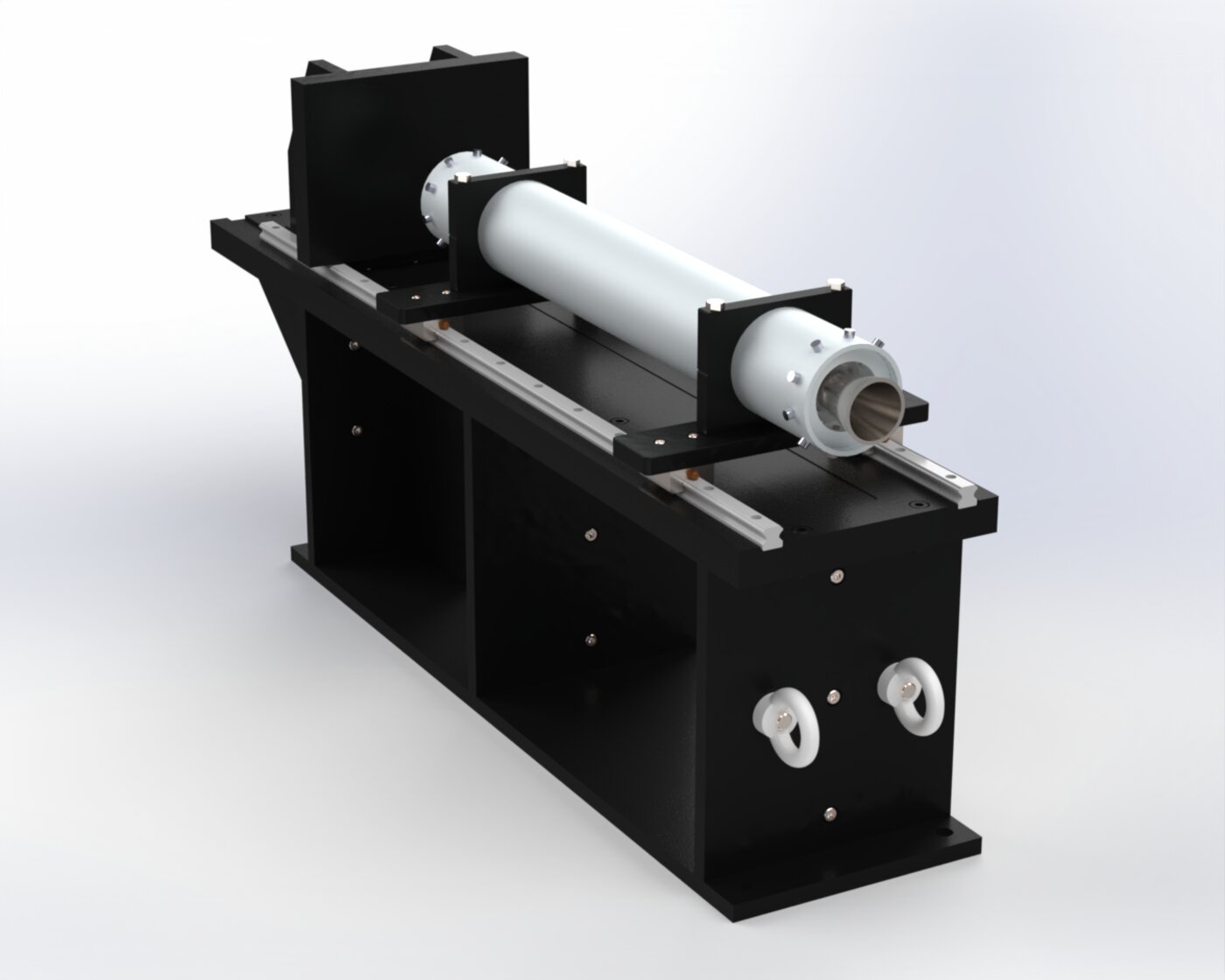
Design and build of my own static test stand for high-power solid rocket motors. It's a personal project that I own, though I loan it to the Asociación Costarricense de Cohetíería for its test campaigns — partly because I wanted access to a test stand of my own, without needing any outside institution's approval to use it.
GIA's original test stand, which I wasn't part of the team that designed but whose design philosophy I came to understand well, was tall, heavy, and robust: built out of steel so it could absorb an explosion if it needed to (which it eventually did), and designed on the assumption that its own weight alone would be enough to hold it in place during a burn — an assumption nobody in the group ever challenged or tested, until the 2019 J-motor incident, when the entire stand took flight during the test.
I designed the new stand around four priorities: fast to build, because there was an immediate need to keep testing motors (so I adapted the base of a recycled machine); strong, because the need to withstand a possible explosion hadn't changed; low-friction, to minimize force lost before it reached the load cell; and stable, directly addressing the flaw I'd identified in the original design: a single linear rail, with no real restraint against the stand tipping or lifting off. The recycled base I used happened to already have two parallel linear rails, which ended up solving exactly that stability problem.
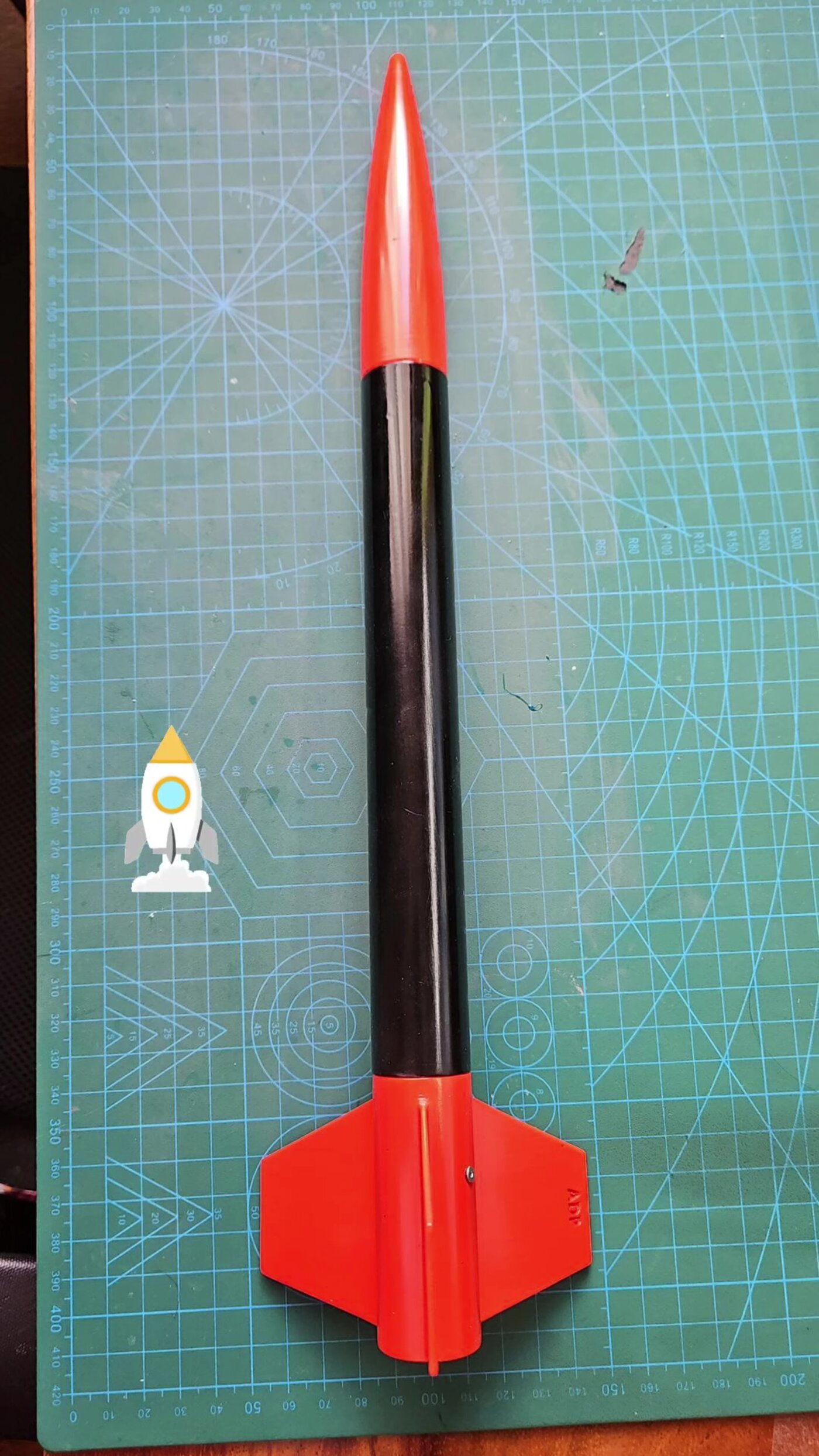
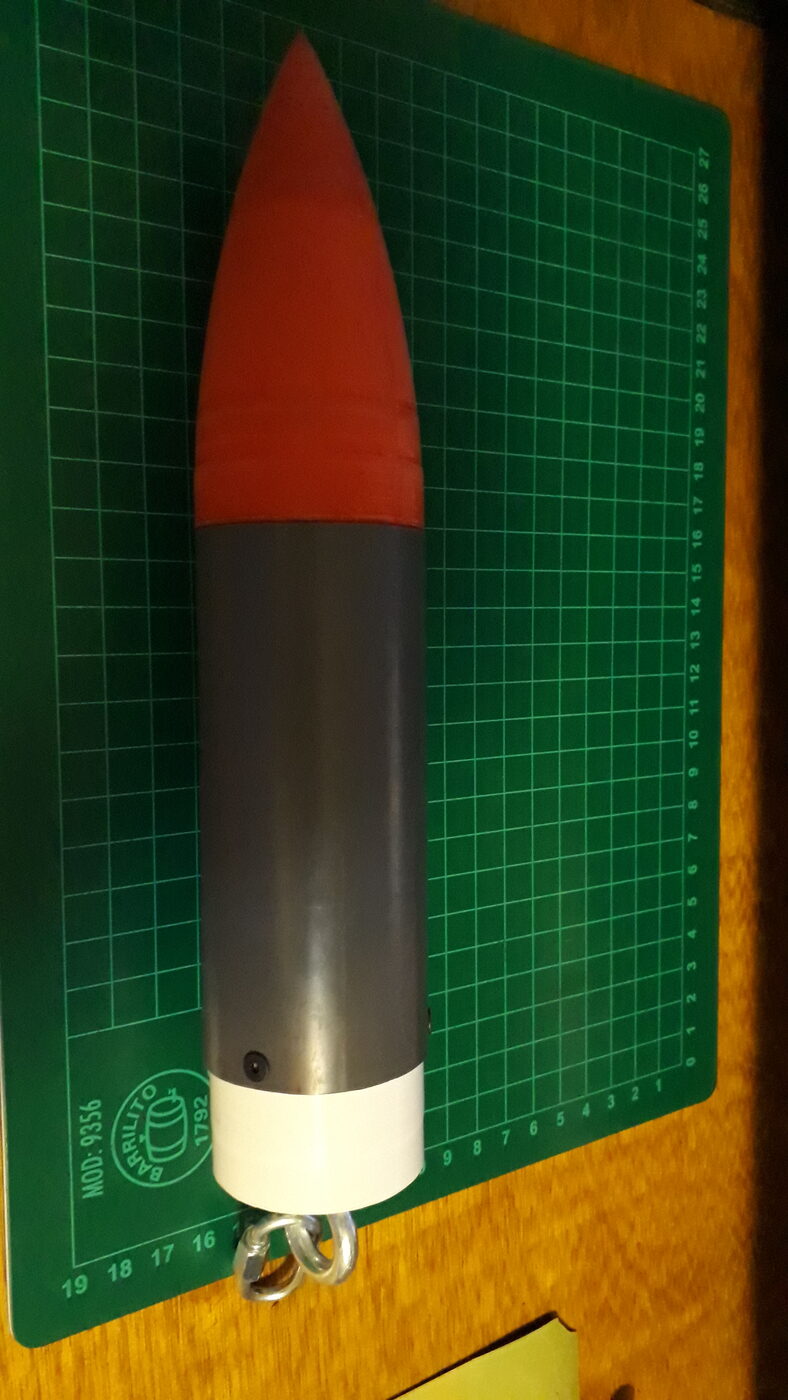
This project is still a work in progress: so far I've only run one test flight, on May 1st, during one of the ACC's open test days. The idea came out of the kids' rocketry activity we ran with the Municipalidad de Paraíso in February 2025 — the reaction from the kids and their parents when we launched a small rocket made it clear there's real demand for small rockets built specifically for demonstrations. Right now it's aimed at that use case rather than being handed directly to kids, though expanding in that direction is something I'd like to do down the line.
I designed the rocket around four constraints: cheap, quick and easy to assemble, very lightweight, and a maximum altitude of 400 ft to stay under the limit set by Costa Rica's Civil Aviation Authority (Dirección General de Aviación Civil). That led to a 3D-printed PETG fin can, a nozzle with a threaded closure, a plastic parachute, and a fuselage built from PVC conduit pipe.
It's only flown once so far, and the motor I'm using still has issues — it isn't delivering the thrust it needs, let alone meeting the safety bar it would need to be used directly with kids. The whole point of keeping it small and portable is to be able to bring it anywhere as part of STEM outreach. Rocketry is a rare activity in Costa Rica, and this project is meant to be a tool for changing that.
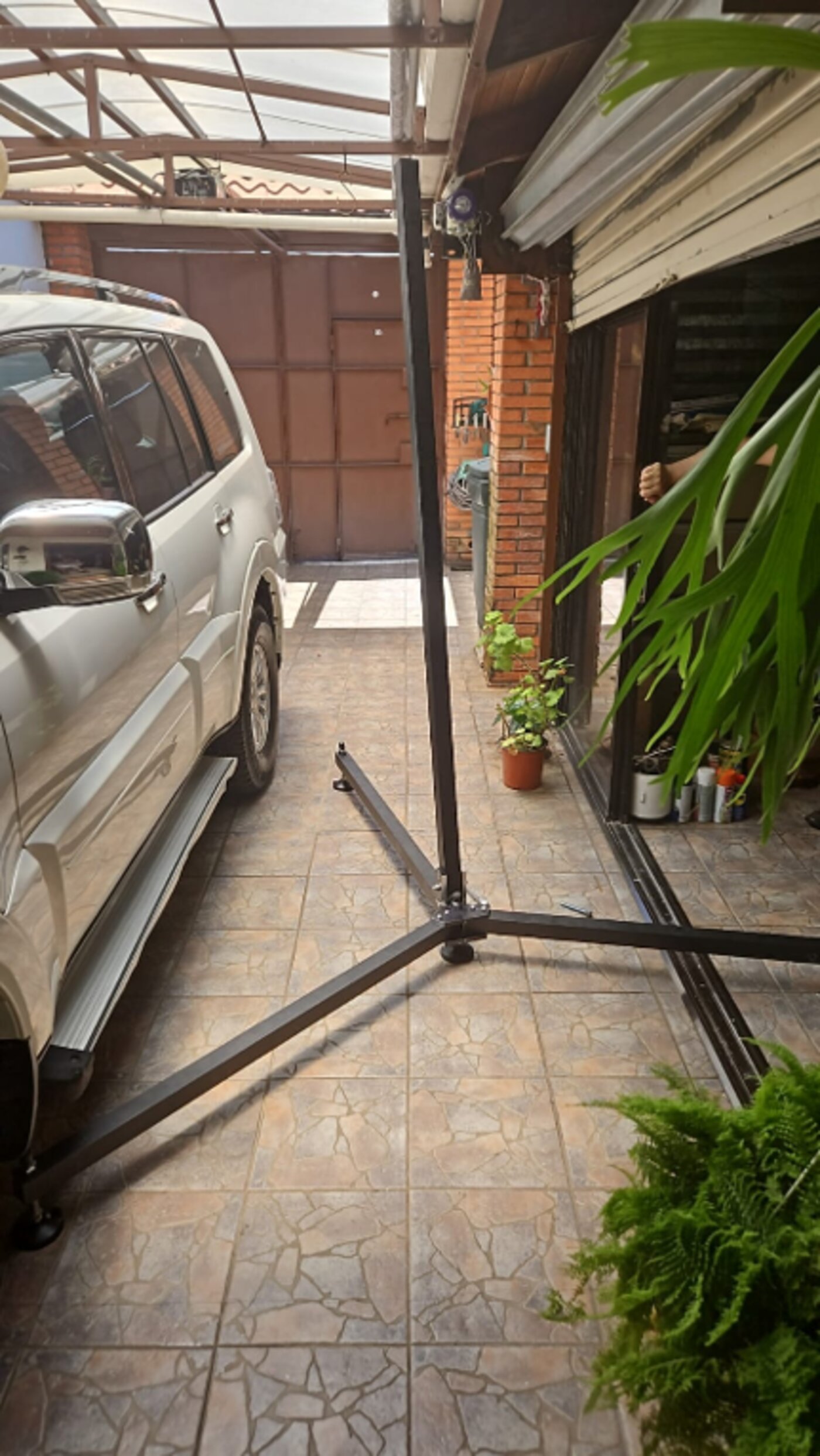
Design and build of a rail launch pad for high-power rocketry, based on proven designs from AEROPAC and John Coker — there was no point reinventing something the community had already validated, so I focused my own work on adapting the design to what actually was different for me: the materials available in Costa Rica.
The original reference design uses a 3-inch rectangular aluminum extrusion, which I couldn't source locally, so I redesigned the structure around a 2-inch extrusion instead. The main arm folds up and down on a standard 10x10 rail, and the legs retract for easier transport. I added threaded adjustable feet to level the rail on uneven ground, along with a circular bubble level built into the design so I could check that leveling precisely. The arm's pivot is just there to make it easier to load the rocket onto the rail — a common feature on rails this size, not a launch-angle adjustment mechanism.
I chose aluminum over steel based on past experience with UCR's steel launch rail, which turned out to be heavy and impractical to transport. The rail is ready to use, but I haven't flown anything off it yet — it's meant for rockets big enough to require additional permits, which are still in progress.
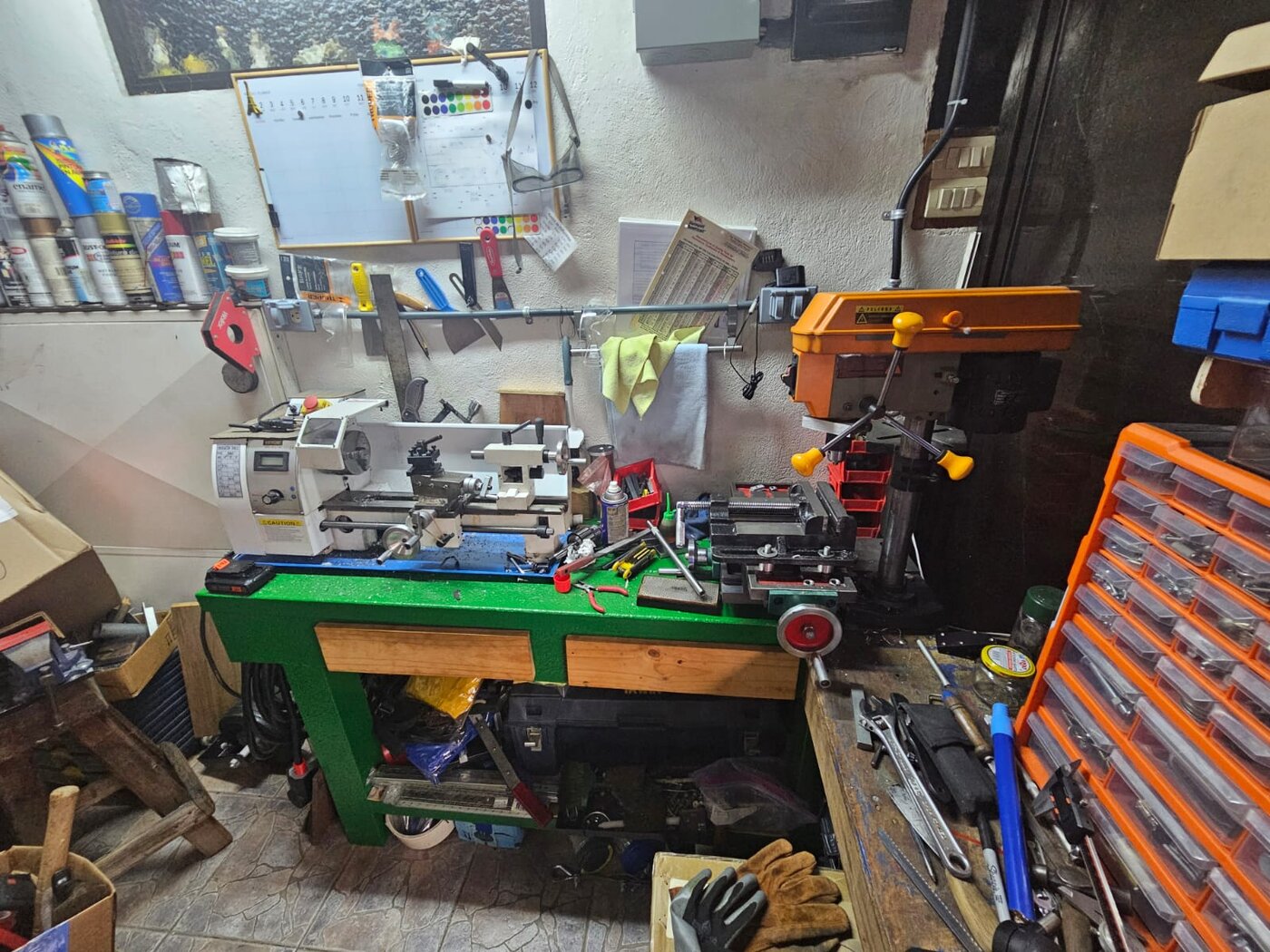
Design and build of a metal workbench to mount a lathe and a bench drill, with two drawers and a lower wooden shelf for storage. It's mainly infrastructure: the shop where I machine parts for the rest of the projects in this portfolio, like the aluminum nozzles for my rocket motors.
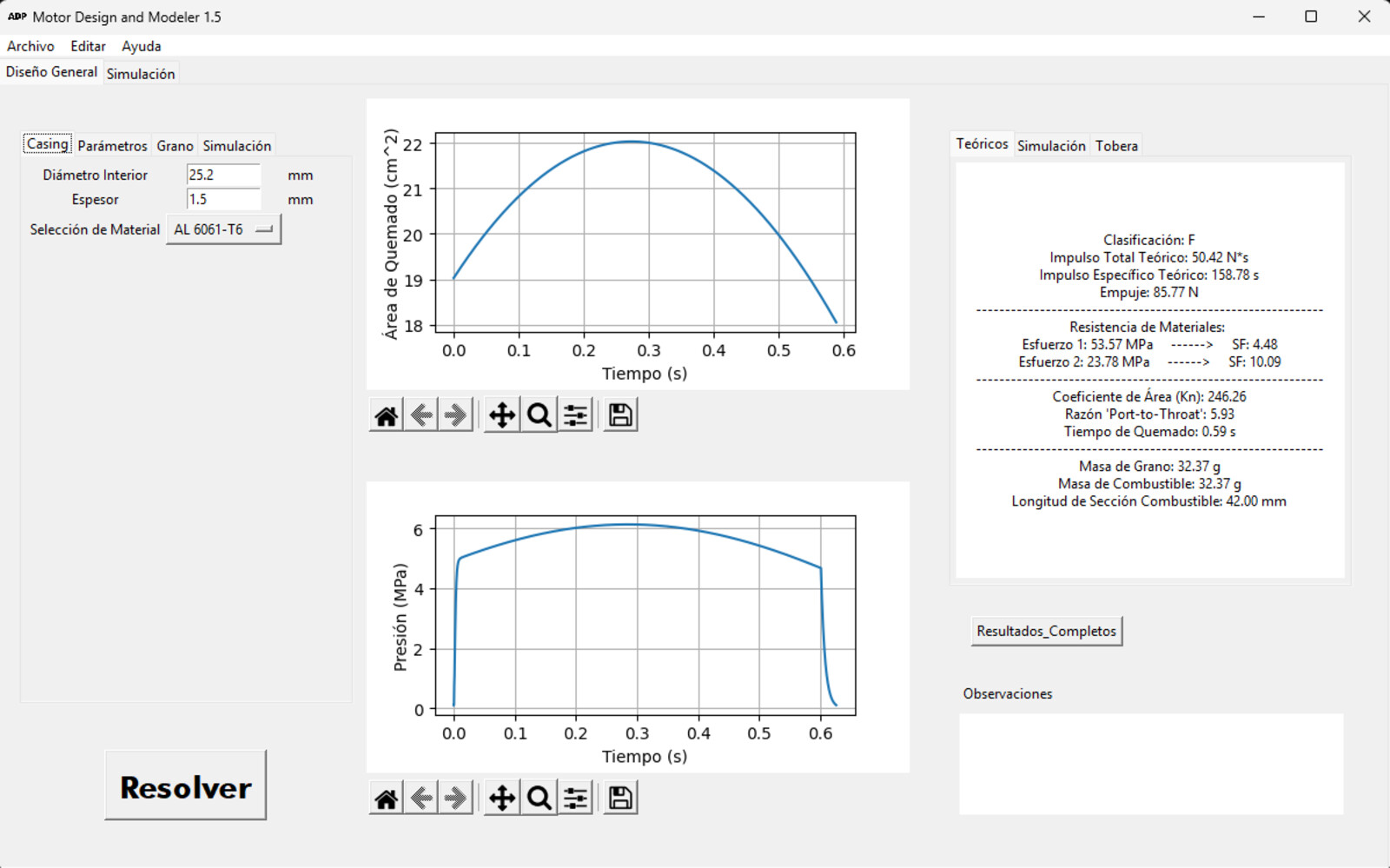
Successor to the Excel spreadsheet I used to design solid rocket motors. I moved to a Python desktop app because Excel's macros fell short of what I needed: recursive calculations, more control over the simulation's time discretization, and, more than anything, I wanted a codebase I could keep building toward a more complete program — something a spreadsheet doesn't let you do in any organized way.
The app keeps essentially the same inputs and outputs as the original spreadsheet (casing, grains, propellant, pressure → nozzle dimensions, burn simulation, material strength), but adds a friendlier interface for editing materials, a built-in library of propellants and materials, and the ability to analyze other people's motor designs using the same simulation engine. It can also export the designed motor as a .rse file (compatible with flight-simulation software like OpenRocket) and generate full PDF design reports.
For now I'm the main user, but it's become the foundation of my design methodology: it's the tool I use to size and validate my own motors, including the 2026 J-motor redesign (see that project). Development started in 2020; the latest stable version, 1.5, dates from 2022.
In 2020 I worked on Prometheus, a small rocket developed together with Francisco Segura: I owned the full mechanical design, while he developed the flight computer. The design included an avionics bay in the nose cone with separation motors, batteries, and a mechanical recovery system.
I tracked a mass budget throughout the design and compared it against the estimated thrust of the selected motor. That analysis showed the electronics, battery, and other avionics components would need a bigger motor than the fuselage could actually accommodate — a structural problem with the design, not something fixable by tweaking individual parts. Rather than keep investing time in a design that no longer closed, I decided to shelve it and pick it back up from scratch on a future redesign. Even so, it was a valuable exercise in mechanical design integrated with avionics.
Predecessor to today's Asociación Costarricense de Cohetíería (ACC): an informal working group formed by members of four Costa Rican aerospace organizations — UCR's Aerospace Engineering Group, GIA (which I was already in the process of leaving), TEC's TECSpace, the newly formed Society of Women in Space Exploration (SWISE), and the Asociación Centroamericana de Aeronáutica y del Espacio (ACAE, which I wasn't yet part of). The shared motivation was simple: Costa Rica is a small country, and working in silos hurts everyone who wants to see local rocketry grow.
I was one of several members, not the organizer, but as one of the more senior people involved at the time, I ended up taking on a co-lead/mentor/technical advisor role. I ran several workshops, since the group's main limitation at the time was a lack of shared technical knowledge. It was in the JCC where we started identifying the needs and ideals that would, years later, get replicated in the ACC — several JCC members would go on to help found the association. It's not a direct line, but a lot of what defines the ACC today has its roots in what we started here.
The group produced several workshops and one motor test, but dissolved when the pandemic hit in 2020.
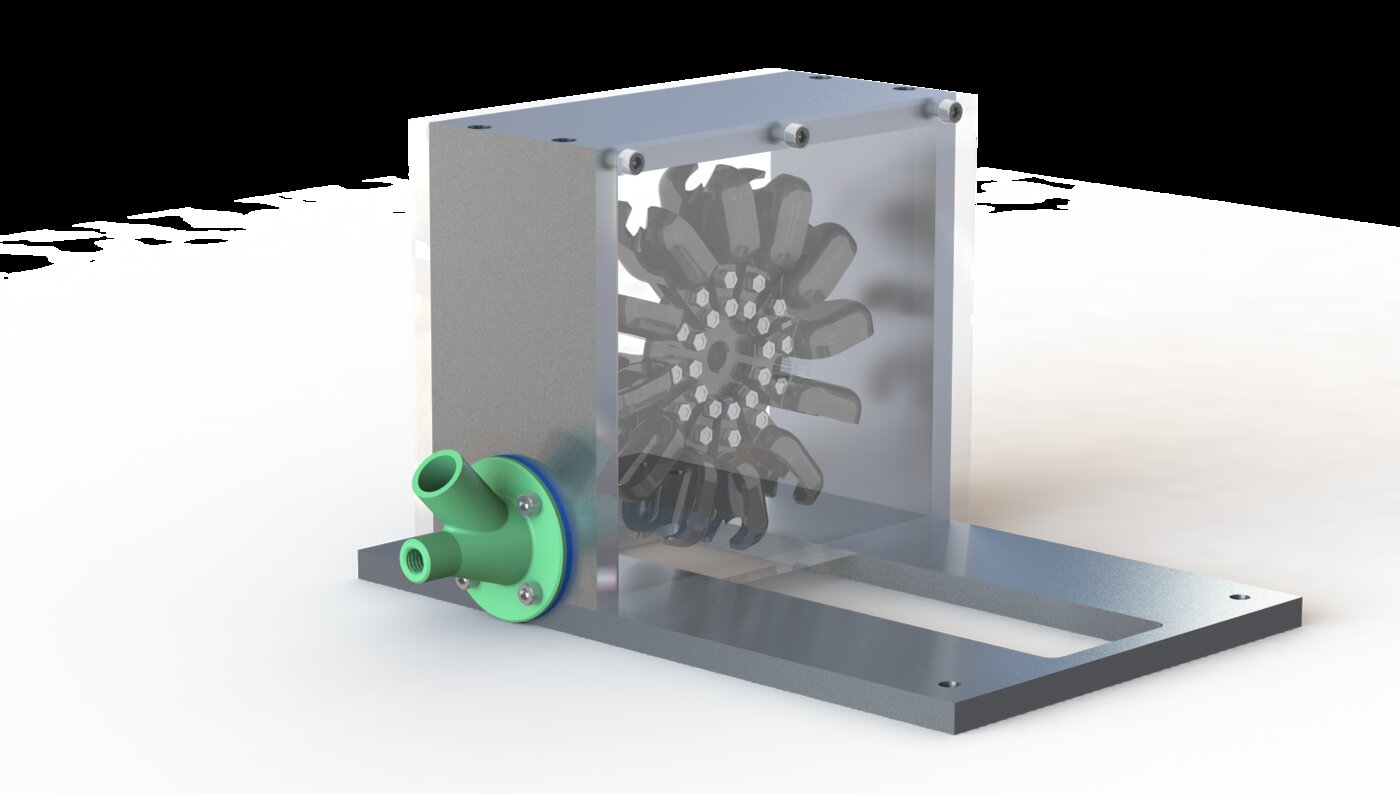
As part of my work at Marostica S.A., I designed and 3D-printed a Pelton-type runner for a feasibility study: the company wanted to evaluate whether 3D printing could make Pelton runners viable for small-scale micro-hydro generation applications. A real test site was identified, which is where the design numbers came from: a flow rate of 2 L/s at a 30 m head, for an estimated 0.5 kW of power. I also designed the injector, with an adjustable needle valve to control the jet onto the buckets.
A Pelton design was chosen because it performs better than other turbine types at high heads like the test site's, but its traditional manufacturing process is complex and expensive, which makes it hard to justify economically for small applications. The core question the study was trying to answer was how long a 3D-printed runner could operate before needing replacement: since printed runners are relatively cheap to produce, there was a real case for treating them as a replaceable wear part instead of an expensive, durable casting — a shift in economic model, not just manufacturing method.
Unfortunately, the project never made it past the early prototype phase.
Video of the incident: the test stand lifts off during the static fire.
As coordinator of GIA's (UCR's Aerospace Engineering Group) Propulsion Group, I was the de facto lead on this J-class motor's design, though it was a team effort. We used KNSU propellant in a 3-grain BATES configuration, with a design thrust of 780 N.
During the static test, the test stand took flight the moment the motor ignited. The cause was obvious immediately: we knew in the moment the test wasn't going to be valid, since the stand's movement would show up directly in the load cell data. The movement was violent enough that it also ripped out the load cell's cable, damaging it beyond repair — so beyond rethinking how to anchor the stand, we also needed to source a replacement load cell. What did catch us off guard was the level of erosion the nozzle suffered during the burn.
Due to timing, I left the project shortly after to start working on my thesis, and GIA never followed up on it. The motor sat unfinished for seven years, until I picked the design back up on my own in 2024 for Part 2 of this project, directly addressing both problems identified here: the test stand's lack of anchoring and the nozzle erosion.
Video of the personal rocket flight, during the same trip to Black Rock Desert.
CUSUCO was the autonomous rover we built at GIA for the ARLISS 2018 competition (AEROPAC/TRIPOLI): a vehicle designed to be deployed from 4 km altitude by a high-power rocket, survive the landing impact, and navigate autonomously across the terrain. I was the mechanical lead on the project and designed and manufactured a large share of its components.
The tires were based on an airless tire concept: we wanted something lightweight but resistant, and we were also interested in adopting a technology that was still relatively new at the time. I designed and 3D-printed them in flexible TPU to absorb the landing impact without relying on inflatable tires, which could puncture or lose pressure on a hard impact. The rim, on the other hand, I machined out of aluminum with a revolved H-beam cross-section — a geometry that keeps weight low while offering far more strength than the other concepts we considered.
The rover survived the drop with no mechanical damage, validating the structural design under a genuinely extreme deployment scenario. It wasn't able to move once on the ground, though, due to programming errors in the navigation system — a failure outside the scope of the mechanical design, but one that kept the mission from being completed.
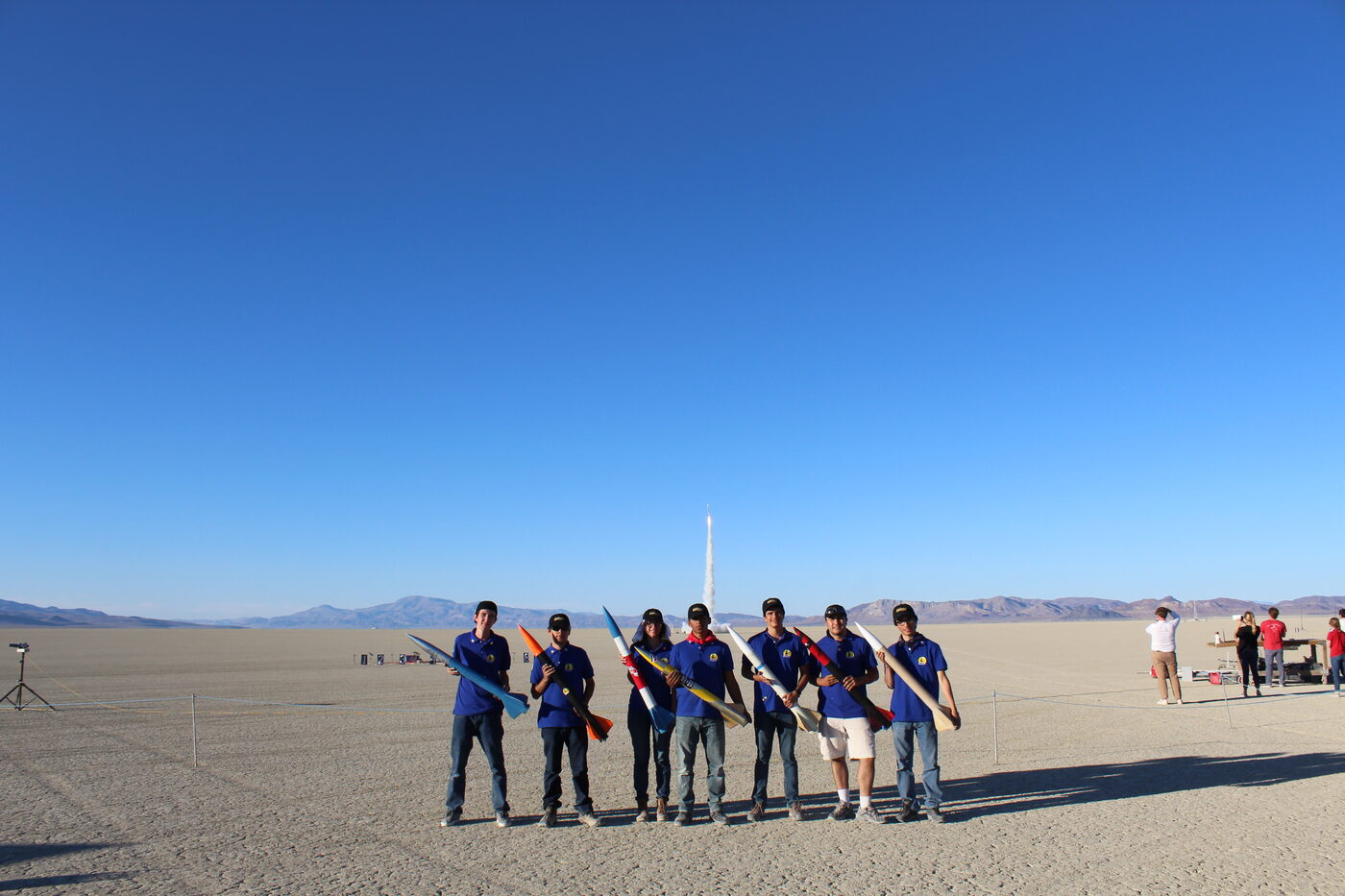
Taking advantage of the same trip to Black Rock Desert for ARLISS 2018, I also flew a personal rocket together with Mauricio Alfaro.
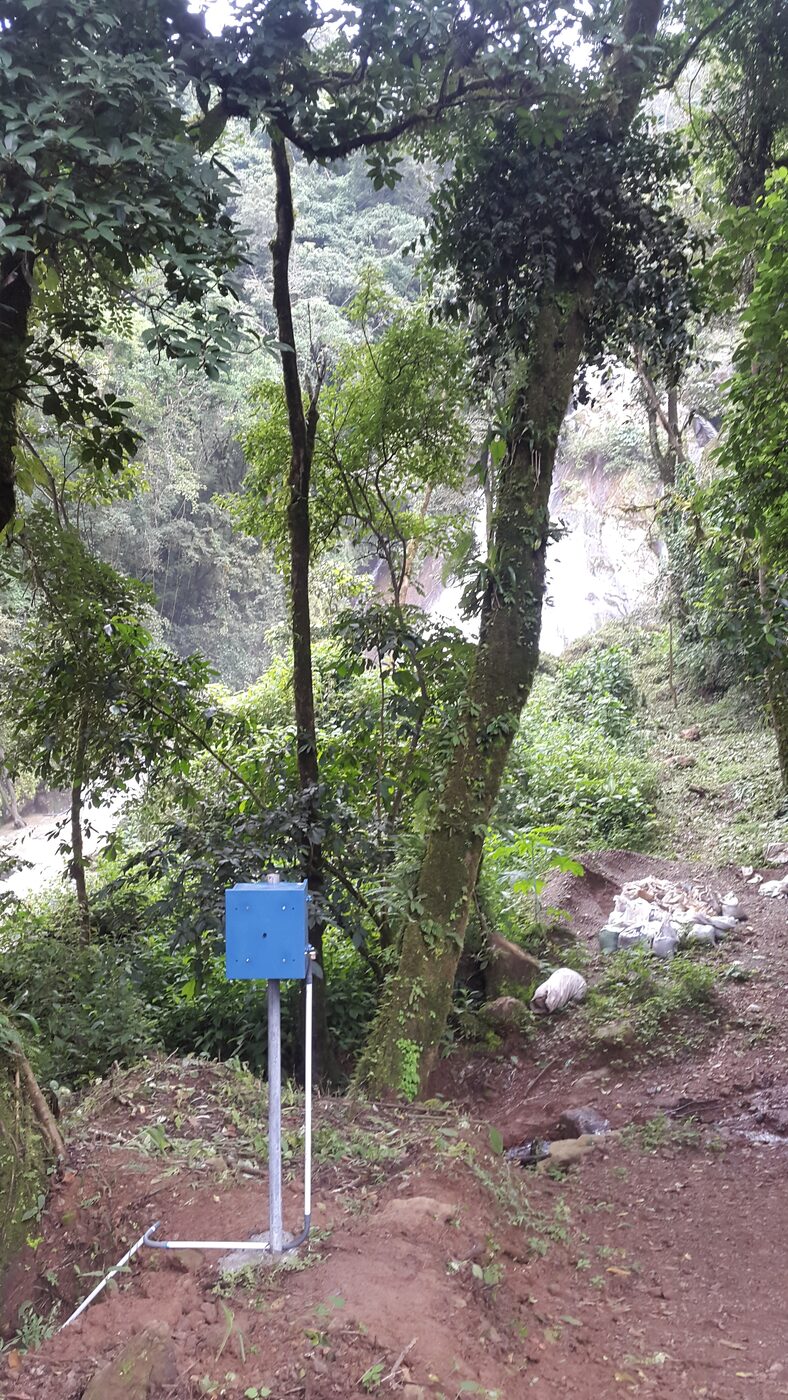
As part of my work at Marostica S.A., I designed, built, and installed a flow rate measurement system for a hydroelectric plant feasibility study. The existing measurements up to that point were taken manually, once a day, which didn't capture the river's real variability throughout the day — a genuine problem when planning energy production, since water level rises and falls noticeably depending on the time of day. The system I designed gave continuous visibility into that variability.
The system was based on an Arduino board reading a pressure sensor placed at the bottom of a measuring weir built into the river: by measuring the pressure of the water column above it, we could derive its height and, from there, the flow rate passing through the channel. I placed the sensor to the side of the reservoir the weir creates, so a river surge wouldn't hit it head-on with full force, and mounted the data logger well above the highest known water line to protect the electronics. Even with those precautions, we weren't sure the system would hold up to a high-impact event like a tropical storm, let alone a hurricane.
The station ended up logging data continuously for several months, surviving both Hurricane Irma and Tropical Storm Nate in 2017. Combined with rainfall data from a nearby weather station, those records gave a much fuller picture of the river's behavior during storms and, later, during the dry season — when the terrain's water absorption changes entirely.
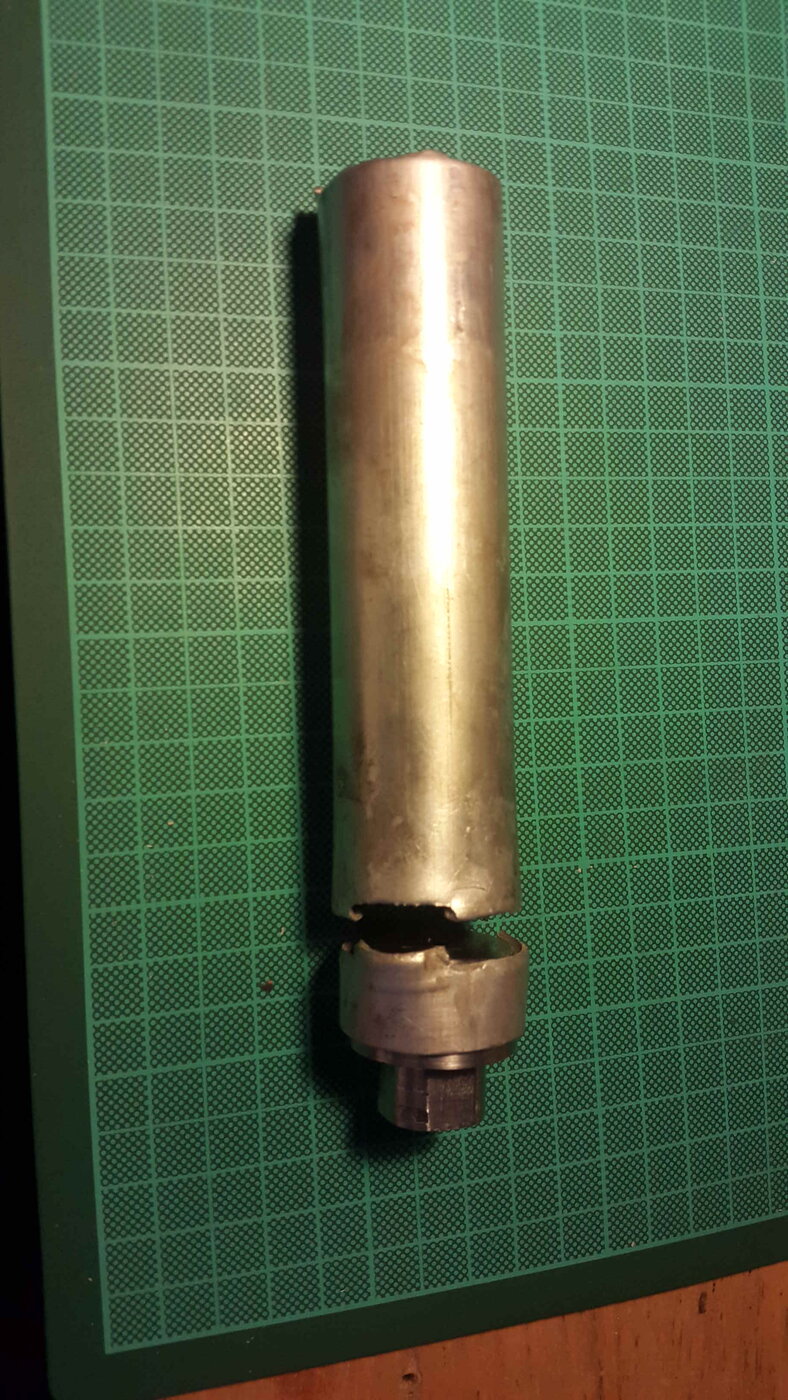
As coordinator of GIA's Propulsion Group, I identified the need to investigate a series of explosions we were having in our rocket motors: we suspected the 6063-T5 aluminum tubing used as the casing might be defective. At the time I was taking a metrology course at university and needed a project for it, so I used the opportunity to turn this real investigation into my class project.
I ran a round of tensile testing (ASTM E8/E8M, five specimens, Instron 3367 universal testing machine) to confirm the material's properties. The measured ultimate strength, 194.4 MPa ± 8.1 MPa, came out above the 185 MPa reference value, which let us rule out material failure as the cause of the explosions. The measured yield strength and elastic modulus did come in below reference — something I attributed to limitations in the test setup rather than the material itself.
Ruling out the material meant we had to keep looking for the real cause, which we eventually found in the propellant characterization: it had been characterized incorrectly, and that turned out to be the actual cause of the explosions. With a corrected characterization, we fixed the motor design. That explosion was, in fact, the first in what would become my longest-running project: G-motor development, which I document separately.
Video of the Level 1 certification flight, Black Rock Desert (September 14, 2016).
In September 2016 I traveled with fellow members of the Aerospace Engineering Group (GIA) to Black Rock Desert, Nevada, to get certified in high-power rocketry — both Level 1 and Level 2 — with the TRIPOLI AEROPAC prefecture, during the ARLISS 2016 event. I flew my certification rocket, "El Cadejos," guided by my mentor, Becky Green.
I did both levels on the same trip, which is uncommon: TRIPOLI doesn't particularly encourage it as general practice, since it skips the natural learning progression the two levels are meant to build, though it's tolerated for logistics and cost reasons when an international trip is involved. It does require having a solid grounding in rocketry before attempting it.
These certifications were the starting point of my relationship with TRIPOLI, which years later would lead me to found and lead the TRIPOLI Costa Rica prefecture, and they laid the groundwork for the larger motor projects I'd go on to develop with GIA.
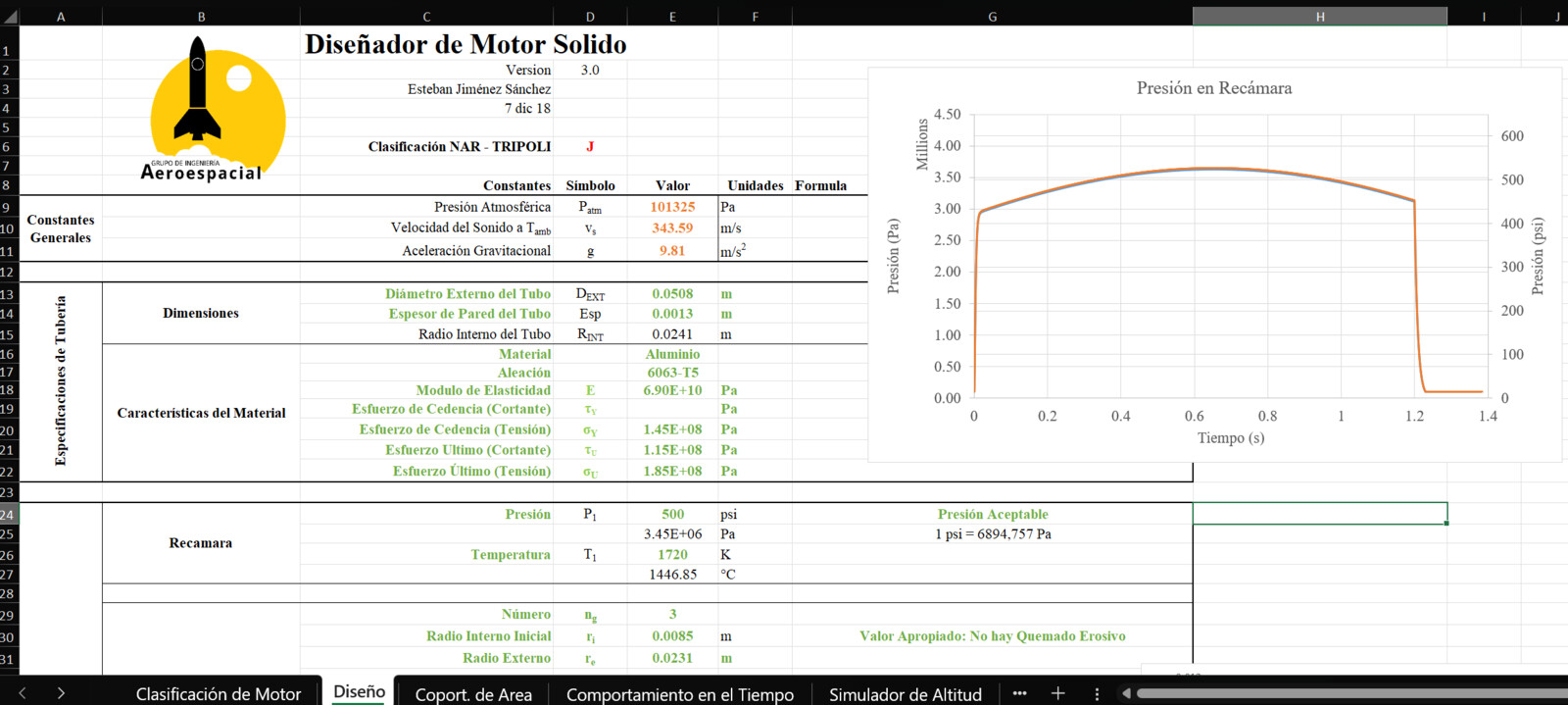
The first tool I used to design solid rocket motors: an Excel spreadsheet built during my time with the Aerospace Engineering Group. Given the grain dimensions, propellant characterization, casing specification, and desired chamber pressure, it calculated the optimum nozzle dimensions. It also produced a basic time-domain simulation of the motor's behavior, including the transients at the start and end of the burn, and calculated material strength under motor loading, accounting for the screws holding the assembly together.
It was GIA's main motor-design tool for years, and even though it's no longer the primary one, I know it's still used there to double-check results or evaluate alternatives. I also know it's been used by other aerospace groups, like TECSpace, and it has reach beyond Costa Rica: at the 2024 Central American Space Congress (CEC) in Guatemala, a colleague from AGICE (Asociación Guatemalteca de Ingeniería y Ciencias Espaciales) asked me direct questions about how it worked and told me they were actively using it. I don't know the full extent of its use today. I still use it myself for teaching, since it shows the calculations step by step — which makes it genuinely useful for that.
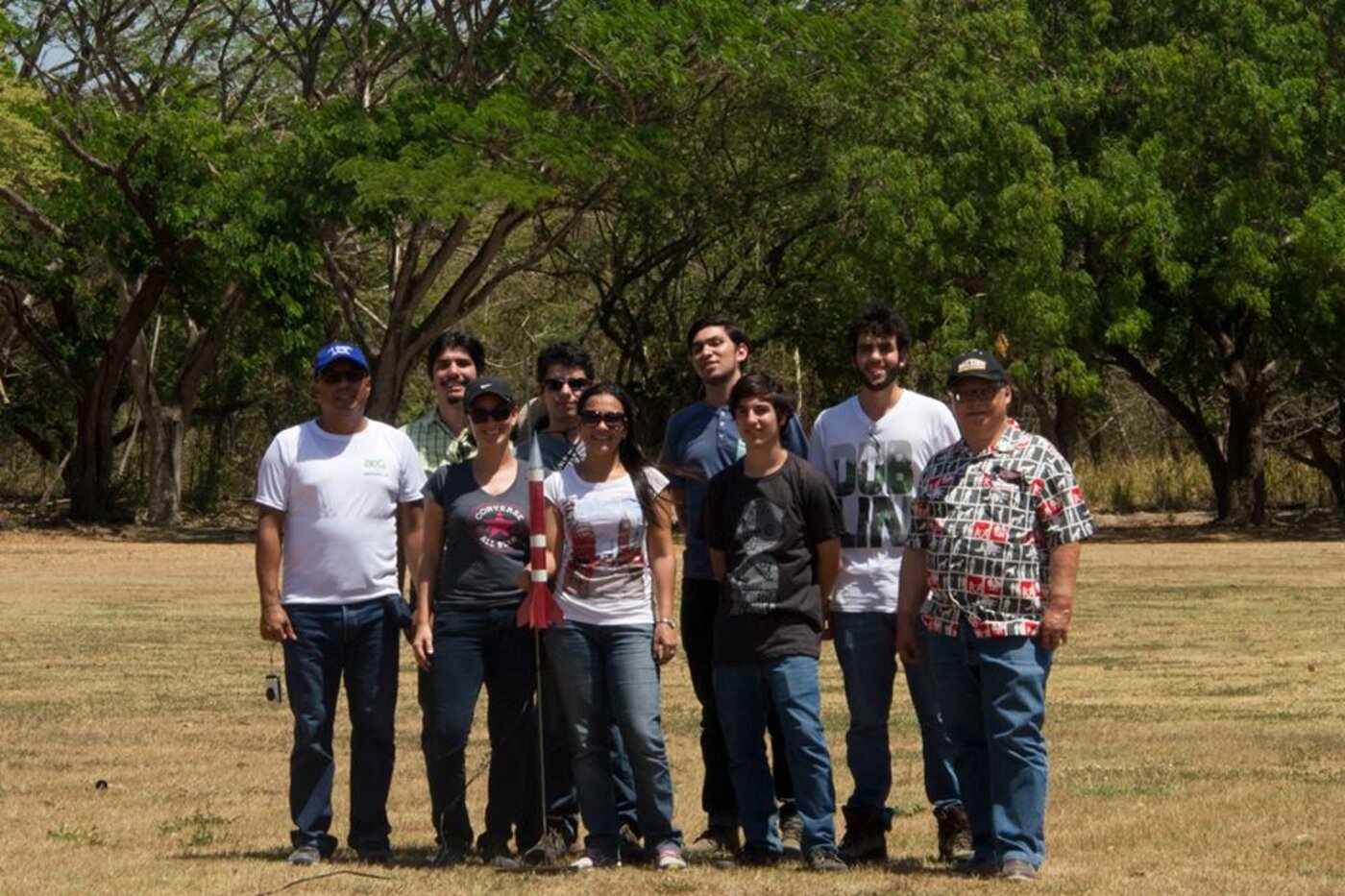
I took part in the earliest projects of the Aerospace Engineering Group (GIA) starting in March 2015. Around this time I began developing solid rocket motors, aiming to professionalize the practice and get some tangible results. The group's first motors were simple PVC tubes packed with a hand-compacted mixture of potassium nitrate and sugar (KNSU).